Inaugural Address
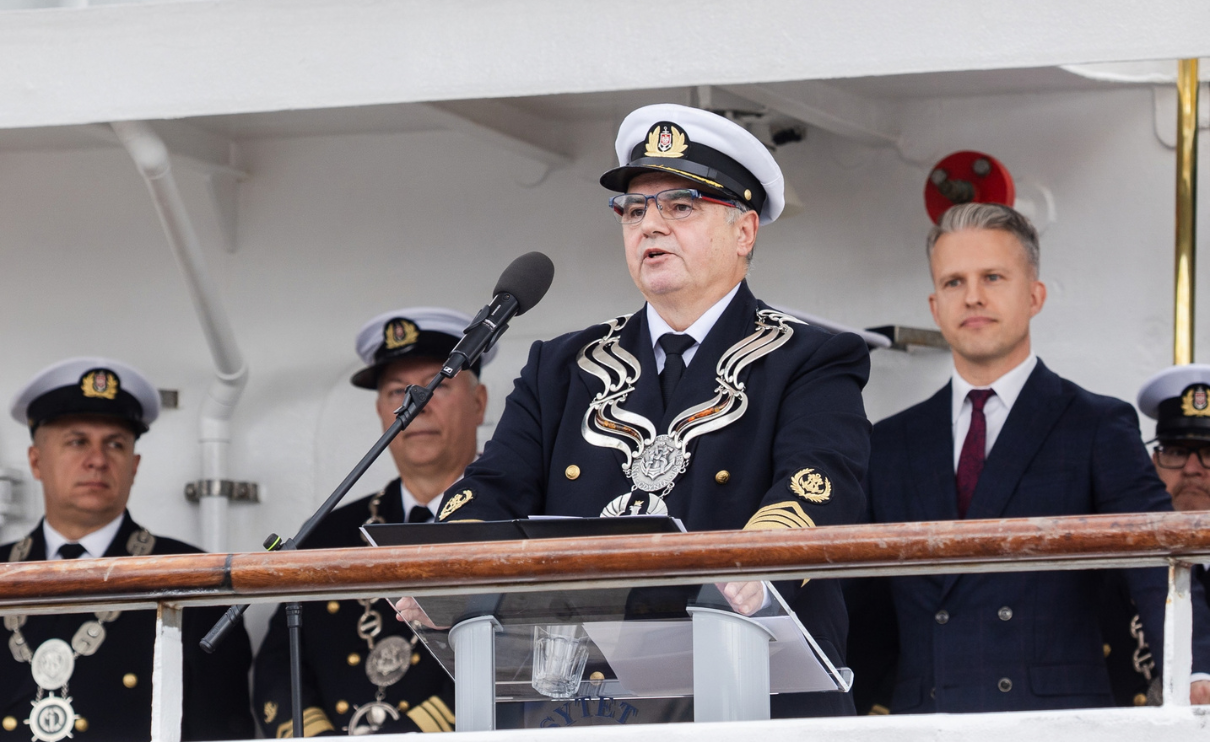
Inaugural Address of the Rector of Gdynia Maritime University,
Professor Adam Weintrit
Ladies and Gentlemen,
The inauguration of the 2026/2027 academic year is a celebration of the entire Gdynia Maritime University community. It is an exceptional day, symbolically opening another chapter in the life of our academic community, but above all, it is a celebration of those who today join the ranks of our University's students and doctoral candidates.
I extend a warm welcome to all those who have chosen our academic programmes and decided to commit their future to our University, and by extension, to the sea. I am confident that you have made the right choice!
Dear Students,
Today, 3 October, during your solemn matriculation in the presence of the University authorities, the Senate, the wider academic community, and our assembled guests, including your families and friends, you join the student body of the oldest maritime higher education institution in the country – Gdynia Maritime University; an institution that for more than 106 years has continuously educated future officers of the merchant fleet, as well as shore-based specialists for the maritime economy.
Dear Doctoral Candidates,
You are beginning your education at our University's Doctoral School. Your presence here is a particular source of joy and pride for me, as it is you who are the future of Polish science, the hope for its further advancement. I congratulate you on your choice of a maritime path for your further academic career and look forward to the results of your research and your doctoral theses.
Ladies and Gentlemen,
The inauguration of the academic year provides an excellent opportunity to briefly recall the history of the founding of our University, whose origins date back to 1920, when the decision was taken at the national level to establish the Maritime School in Tczew. On 10 February 1920, General Józef Haller performed the symbolic act of Poland's wedding to the sea in Puck; on 17 June, Polish maritime education was established; and as early as 8 December, the solemn inauguration of the school year took place, and the first classes were held at the school in Tczew. Among the students were young people who had experienced the Polish–Soviet War, undertaking their education at what were then two Faculties: Navigation and Marine Engineering.
Dear Students,
Today at the University, we educate students at bachelor’s, master’s, and doctoral levels across five Faculties: the Faculty of Electrical Engineering, the Faculty of Navigation, the Faculty of Marine Engineering, the Faculty of Management and Quality Science, and the Faculty of Computer Science.
At bachelor’s level, we offer 13 programmes of study (including two in English) and 30 specialisations; at master’s level, 11 programmes and 24 specialisations.
In total, approximately 5,000 students (4,930) study with us. On 1 October, 2,119 students began their first year of study, including 1,423 full-time bachelor’s and master’s degree students and 696 part-time students; the highest numbers enrolled in the following programmes: Navigation, Management, Transport, and Electrical Engineering.
Our youngest faculty, the Faculty of Computer Science, established in 2024, will in two years move to the state-of-the-art GMU Computer Science Centre currently under construction. At the same time, we are developing infrastructure to serve our students. Later this year, we plan to sign a contract for the construction of a new student residence.
Ladies and Gentlemen,
Remaining on the subject of investments: the past academic year was rich in milestone events that bring us closer to the commencement of construction of a new training ship. We have completed the first tender procedure, which – although concluding without the submission of bids – provided us with valuable experience and allowed us to better understand the needs and conditions of the current shipbuilding market. We applied the lessons learned from this procedure to the subsequent tender. I trust that the tender announced by the University on 24 August will prove successful this time, and that in just a month I will be able to share with you information on which shipyard will design and build the successor to the Dar Młodzieży. This is a great historical challenge for us all.
Dear Students,
It is no coincidence that I mention the Dar Młodzieży at the very outset of my address, as the University’s training ships are what set us apart from other maritime universities, not only in Poland but also abroad.
The Dar Młodzieży is not merely a ship – incidentally, one of the most beautiful tall ships sailing the seas and oceans today. It is a floating academy that every year, for several weeks or sometimes months, becomes a home, a lecture theatre, and a place of practical training for hundreds of young people – not only students of our University, but also pupils of maritime secondary schools and students from partner universities abroad.
The Dar Młodzieży is not just a floating maritime school; it is a school of life, a school of building relationships, strengthening friendships, a school of acquiring respect for that exceptional force of nature that is the sea, and a school of building trust and responsibility. In short – a school of character.
Indeed, nothing shapes character quite like facing challenges and often adversity together. And I assure you that sailing the seas and oceans can be a formidable challenge. There are days when the sun shines, but there are also days when storms sweep the deck, when the mounting force of the wind requires the sails to be furled, and when the physical strength of hands and the power of a cohesive group working together shoulder to shoulder become essential. The sea can amaze and surprise; you must be prepared for unexpected changes in the weather. You must be ready to confront your own weaknesses and doubts. For they, too, will inevitably arise. That is why we will take you, dear students of maritime programmes, out onto the water, to sea, and onto the ocean, for maritime practical training is the finest school of life and study.
Dear Students,
Each of you has received an exceptional gift: the songbook Śpiewnik szant, piosenek żeglarskich oraz pieśni o morzu [A Songbook of Shanties, Sea Songs, and Songs of the Sea]. At the end of this collection, several years ago, I included the lyrics to the song You’ll Never Walk Alone. I suggest that in your free time, ideally today, you reflect upon the words of this song, which so fittingly capture what we do. I would like this song, in time, to become the second anthem of our community. A splendid rendition of this piece was uploaded to YouTube during the pandemic by our Gdynia Maritime University Academic Choir under the baton of Dr Karol Hilla, giving me a delightful surprise for which I am very grateful.
Ladies and Gentlemen,
We are defined by the sea! Hence, the majority of you, dear Students, will have the opportunity to put the knowledge acquired during theoretical classes to the test, taking part not only in the aforementioned maritime training aboard our training ships, but also in numerous workshops and laboratories, as well as training on our many sophisticated simulators that reflect maritime realities with ever greater precision. Our partner companies, whose representatives are here with us today, will also open their doors to you, enabling you to test and refine the knowledge gained at the University in an authentic work environment and, through practical experience, acquire additional skills.
Dear Assembled Guests,
At Gdynia Maritime University, we train our students aboard the aforementioned Dar Młodzieży. This training is demanding, yet it brings substantial rewards, such as the experience of deep-sea voyages and the forging of lifelong friendships, which frequently occurs during international sailing events. All of this shapes people of the sea and creates an invaluable store of memories that bind our students, and subsequently our graduates, for life.
A month ago we hosted a group of alumni from the Faculty of Navigation who, 50 years ago in 1976, took part in a voyage on the Dar Pomorza to the United States, where they participated in the celebration of the Bicentenary of the US Independence.
Dear Students,
I trust that among those attending today's inauguration ceremony are cadets who undertook maritime practical training aboard the Dar Młodzieży this year. An exceptional highlight of that training was our White Frigate's participation in the international Sail 250 regatta, organised to commemorate the 250th anniversary of the independence of the United States. Behind you lie thousands of nautical miles during which – much like your predecessors 50 years earlier aboard the Dar Pomorza – you had the opportunity to test yourselves against the power and unpredictability of the sea, while experiencing first-hand the paramount importance of responsibility, teamwork, and mutual trust during such a voyage.
Ladies and Gentlemen,
I had the honour of participating in the culmination of the voyage to the United States of America, an uplifting moment, I believe, for our entire academic community. On 4 July, on the Hudson River in New York, we celebrated not only the 250th birthday of the United States, but also the 44th anniversary of the raising of the Polish ensign on our training frigate, the Dar Młodzieży. We celebrated this anniversary by taking part in the international parade of sail, the focal point of the celebrations marking the 250th anniversary of the United States of America.
On that day, our tall ship sailed proudly not only under the white-and-red ensign, but also under a specially made sail commemorating the centenary of our city of Gdynia. It was a fine and profoundly symbolic touch – after all, Gdynia has been the home port of the Dar Młodzieży for 44 years! And it is my hope that it will remain so even after the conclusion of our ship's service.
In response to numerous inquiries from journalists, I wish to declare that at the present stage, no talks are being held regarding the decommissioning of the Dar Młodzieży or transferring the tall ship to Szczecin or any other city. The Dar Młodzieży remains the property of Gdynia Maritime University and will continue to pursue its core mission of educating and training future maritime personnel. Matters concerning the vessel's future following the end of its service are not currently subject to any binding agreements.
Dear Students,
During this transatlantic voyage, the White Frigate covered nearly 12,000 nautical miles, calling at European ports, the Bahamas, and the United States – in Norfolk, New York, and Boston. In total, more than 300 students from our University completed maritime practical training on board.
The voyage was not without its challenges and surprises. Following the passage from New York to Boston, damage to the propeller blades was identified, almost certainly sustained during a squall in the New York roadstead on 3 July 2026, on the eve of the ceremonial parade for United States Independence Day, where a white squall wrought havoc among the surprised vessels preparing at the anchorage for the ceremonial parade that was to take place the following morning.
This demanding transatlantic passage demonstrated, unfortunately, that despite the efforts of the crew and regular maintenance and repair work, the training ship is an ageing vessel, and each successive season brings mounting challenges in keeping the tall ship fully operational. This makes us all the more pleased, and examinations point to the fact that within the next few years, a new vessel will enter service. We have been working intensively on the construction plans and the compilation of detailed documentation for what I hope will be the most beautiful tall ship, for several years now.
Dear Students, Ladies and Gentlemen,
The Dar Młodzieży is not the only vessel on which maritime practical training is conducted. Our students also continue to train aboard the Horyzont II, a training and research vessel that serves as a permanent link in Polish polar projects and represents an integral component of Poland's presence in the Arctic.
Our fleet also includes the research vessel Imor – a floating marine laboratory equipped with latest-generation instruments, used primarily in projects conducted by the GMU Maritime Institute, which underwent a comprehensive class renewal survey this year.
The University also operates the Sailing and Water Sports Centre. This Centre has sailing yachts, a motor yacht, and RIB craft, aboard which students complete sailing and powerboating courses. Then there is the world-unique Ship Handling Centre in Iława, at which the University, in cooperation with Gdańsk University of Technology under the Prof. Lech Kobyliński Foundation for Safety of Navigation, conducts specialised courses and training for captains and pilots to hone their ship-handling skills.
Dear Students,
A student's life is more than just study; I therefore warmly encourage you to pursue your extracurricular passions during your free time.
Those of you who love music and wish to stand on stage alongside world-renowned performers have the opportunity to join the ranks of the aforementioned Gdynia Maritime University Academic Choir under the baton of Dr Karol Hilla. For over 20 years, the choir has successfully taken part in major musical events both in Poland and abroad, performing alongside such luminaries as Andrea Bocelli.
I also encourage you, dear Students, to join the ranks of the GMU Guard of Honour, which presents itself so splendidly during ceremonies such as today's.
Since its establishment in 2019, the Guard has remained a showcase of our University. Its duties include the organisation, security, and ceremonial setting of academic events, as well as representing the University across a range of official functions. I trust that among you, dear First-Year Students, there are those who will choose to bolster its ranks and represent Gdynia Maritime University with pride.
I also hope that many of you will choose to pursue your interests within the University’s student scientific societies – I warmly encourage you to do so!
I would also like to add that there are several active sports clubs at the University: at your disposal are the University swimming pool and the modern Sports and Recreation Centre, complete with a sports hall, climbing wall, fitness and cardio zones, and saunas – make use of these facilities; they are there for you. As the ancient maxim says, "A healthy mind in a healthy body" – take this to heart and care for your physical condition. Our students achieve success in sports competitions, competing, among others, in the Polish Academic Championships. Particular mention should be made of successes in sailing, sport climbing, powerlifting, and swimming.
Dear Students,
Remember also to balance the hours spent in university lecture rooms with rest between classes. Let the Student Zones assist in this, located in the University main building, as well as at the Faculty of Marine Engineering, the Faculty of Navigation, and in the Karol Olgierd Borchardt Main Library.
Care also for your friendships, for fruitful study is supported not only by acquiring knowledge, but also by spending time together. I hope that one of your meeting places will be the iconic Bukszpryt pub&club, host to numerous student events. I also encourage you to take part in events organised by your peers in the Student Parliament, such as the Student Ball and the Gdynia Delfinalia festival, the counterpart to national juwenalia.
Dear Students, Ladies and Gentlemen,
Another opportunity for the integration of our academic community is Sports Day, which culminates in a shared feast for GMU students and staff on the University campus. Unique faculty days are also held across each Faculty, such as Electrical Engineer Day, Mechanical Engineer Day, and Navigator Day. In the past academic year, the Faculty of Management and Quality Science joined this form of celebration for the first time.
Dear Doctoral Candidates,
I congratulate you on embarking upon this next stage of your education and on choosing our Doctoral School. Ahead of you lies further development in your chosen academic discipline. Use this time wisely and effectively so that, in a few years' time, you may take pride in your academic degree, preceded by an impeccably researched and defended scientific dissertation. May the results of your research consistently serve the common good and advance both science and the economy!
Dear Doctoral Candidates,
Ladies and Gentlemen, Recruitment to the Doctoral School enjoys high interest every year; we currently educate 44 doctoral candidates across four disciplines:
- Automation, Electronic and Electrical Engineering, and Space Technologies
- Management and Quality Sciences
- Earth and Environmental Sciences
- Civil Engineering, Geodesy and Transport.
Ladies and Gentlemen,
As a result of the evaluation of scientific activity quality conducted in 2026 for the years 2022–2025, GMU received category B+ in four disciplines: Civil Engineering, Geodesy and Transport; Management and Quality Sciences; Information and Communication Technology; and Earth and Environmental Sciences.
In the case of three disciplines, applications for reconsideration were submitted. This concerns the disciplines: Automation, Electronic and Electrical Engineering, and Space Technologies; Mechanical Engineering; and Management and Quality Sciences. We trust that these will conclude with an increase in the awarded category.
Ladies and Gentlemen,
Gdynia Maritime University conducts outreach and popularisation activities as an integral part of its social mission – these include the following initiatives:
- Maritime Festival of Science
- Pomeranian Researchers' Night
- Popular science lectures delivered to commemorate the centenary of the city of Gdynia.
Furthermore, GMU secured funding for another project promoting science entitled Maritime Science Academy – from the Baltic to the Mountains, a project funded by state budget resources awarded by the Minister of Science and Higher Education under the Social Responsibility of Science III programme.
Ladies and Gentlemen,
In the 2025/2026 academic year, the implementation of 25 new externally funded projects was initiated, including 4 international and 21 national projects, of which 9 were research projects and 12 were general development, educational, and science promotion projects.
In total, 58 projects were carried out in the 2025/2026 academic year, including: 26 international and 32 national projects, of which 33 were research projects, and 25 were general development, educational, and science promotion projects.
Ladies and Gentlemen,
Today, the sea is no longer merely a window to the world, but also an arena of geopolitical tension, bringing with it ever-newer challenges and constant technological development. All of this is also tied to the emergence of new industries, including those connected to the offshore sector.
In this context, I would like to highlight the GMU Centre for the Offshore Industry – a key facility and the nucleus of a Polish offshore valley, conducting marine research and measurements for the offshore wind energy sector. For establishing this Centre, I had the honour of accepting the "Amber Duck" on behalf of the University in October last year – a prestigious award presented by the Polish Chamber of Maritime Commerce.
Entering the offshore sector demands specialised preparation, and labour market demand for experts in this field continues to grow. For this reason, the vast majority of programmes we offer incorporate subjects related to the offshore industry in their curricula.
Here, I would also like to draw attention to our University's postgraduate offer, particularly the programmes connected to this industry. I refer here to the Executive Offshore Wind MBA, which we have delivered successfully for several years in partnership with Hochschule Bremerhaven (Germany) and Business Academy South West (Denmark).
Considerable interest is also enjoyed by subsequent cohorts of the postgraduate programme "Risk Management in the Offshore Mining and Wind Energy Industries".
Ladies and Gentlemen,
The achievements of our researchers are recognised both nationally and abroad. This is confirmed by the presence of Gdynia Maritime University scholars among the world's most highly cited researchers, listed in the World’s Top 2% Scientists 2025 ranking.
This is a ranking covering the most influential researchers from around the world, prepared by researchers from Stanford University in cooperation with Elsevier BV and SciTech Strategies.
Included among those recognised for their career-long scientific achievements in 2025 are six researchers from Gdynia Maritime University. Gdynia Maritime University, through its Technology Transfer Office, became the first university in the region accredited in the field of technical and environmental consulting in the Business Environment Institutions Database as part of the project Pomeranian Information and Advisory Services System SPEKTRUM 2030, implemented by the Pomerania Development Agency. At this point, I would also like to highlight the Technology Transfer Office's successes in intellectual property protection.
GMU's achievements in this area comprise:
- patent applications: 6 domestic + 1 European,
- industrial design applications: 2 domestic,
- patents granted for inventions: 5 domestic patents + 1 European patent,
- rights of protection granted for industrial designs: 2 domestic.
Ladies and Gentlemen,
At the beginning of this year, Dr Yohei Sasakawa joined the ranks of our University's honorary doctors.
The core areas of his activity focus primarily on initiatives for maritime safety and ocean protection. For many years, these efforts have been pursued through close cooperation with the International Association of Maritime Universities (IAMU), of which Gdynia Maritime University is an active member. From 2005 to 2025, Dr Yohei Sasakawa served as Honorary Chairman of IAMU, making a significant contribution to the development of international cooperation among maritime universities.
I am proud of the fact that a figure so renowned and esteemed within the international maritime community has joined the honorary doctors of Gdynia Maritime University.
Dear Students, Ladies and Gentlemen,
As I have already mentioned, Gdynia Maritime University is an active member of the International Association of Maritime Universities – IAMU, where Dr Yohei Sasakawa served as Honorary Chairman from 2005 to 2025, and which I had the honour of chairing from 2023 to 2025. Next week, a group of several of our lecturers will participate in the next IAMU Annual General Assembly in Split.
Our activity in IAMU, cooperation with the International Maritime Organisation – IMO – and presence in other international organisations vital to the maritime economy allow us not only to participate in discussions on the future of maritime education and the maritime sector, but also to exert a tangible influence on the directions of their development. We therefore consistently expand our international relationships, seeking new partners and areas of collaboration. The past academic year brought new opportunities in this regard.
In my assessment, several meetings were particularly significant in the context of the University's further internationalisation. In April this year, the University hosted representatives of the Arab Academy for Science, Technology & Maritime Transport (AASTMT). The purpose of the meeting was to discuss opportunities for expanding cooperation in education, as well as student, doctoral candidate, and academic staff exchanges between our universities.
Here, it is worth emphasising that the Arab Academy for Science, Technology & Maritime Transport is an important university centre supporting the development of the maritime economy in the Middle East and North Africa region, whose maritime students are educated according to a model closely resembling the one in place at our University, where practical training is accorded equal weight alongside theoretical study.
Ladies and Gentlemen,
Fewer than two weeks ago, a visit took place to the Republic of Angola by representatives of the authorities of Gdynia Maritime University and the company Enamor. The purpose of the visit was to hold talks with representatives of the government administration of the Republic of Angola, the authorities of Namibe Province, and the leadership of the University of Namibe regarding the continuation of Polish–Angolan educational and maritime cooperation, with particular focus on preparing the next phase of the educational project implemented at the Academy of Fisheries and Marine Sciences in Namibe between 2008 and 2019. In its time, this was the European Union’s largest educational project in Africa.
As part of the planned subsequent phase of the maritime education project, measures were proposed aimed at adapting the level of education at the Academy of Fisheries and Marine Sciences in Namibe to international standards applicable in the maritime industry.
The visit took place with the special support of His Excellency Manuel Pedro Chaves, Ambassador of the Republic of Angola to the Republic of Poland, and the Embassy of the Republic of Poland in Luanda, particularly Consul Marta Michalunio-Matys, serving as chargé d’affaires, who assisted the delegation in all ministerial meetings.
Ladies and Gentlemen,
I am convinced that our University's high standing in the rankings of global maritime academies, our scientific and didactic potential, the execution of numerous maritime projects, our engagement in the work of the IMO on drafting and amending the STCW Convention and other global legal acts, alongside the experience of Enamor, which has operated successfully in the maritime industry for over 35 years, will enable the effective, mutually beneficial implementation and completion of this important project. Let me recall that our University participated in the execution of Phases I and II of the project. The scope remaining to be carried out in Phase III aligns with the potential and competences possessed by Gdynia Maritime University.
Our visit followed the inaugural "Africa Day" organised at the University in June this year, during which we had the honour of welcoming the ambassadors of Angola, Algeria, and Senegal. This event became an exceptional platform for dialogue and the exchange of experience between representatives of the academic community, the diplomatic corps, and students interested in student exchange between the countries. I am pleased that the discussions initiated in Gdynia were continued in Angola. An important event in establishing international cooperation was the November visit of the Ambassador of the Philippines to Gdynia Maritime University. Also in November, we hosted representatives of Taiwan. I trust that the coming months will provide opportunities to develop the relationships established during this period, and that the discussions held then will translate into concrete forms of cooperation.
Dear Students, Ladies and Gentlemen,
The process of university internationalisation is driven not only by the demands of the labour market. It is also an important tool influencing the quality of education, while developing the competences of academic staff. It likewise fosters the exchange of knowledge and experience. Internationalisation is therefore today one of the key directions for the development of higher education.
All of this influenced my decision to establish a separate role for the Deputy Rector for International Cooperation. This decision was the result of weeks of analysis by the entire team and arose from the need to clearly delineate two strategic dimensions of cooperation: cooperation with the socio-economic environment, and the internationalisation of University activities, particularly in education. Each of the areas indicated here possesses its own specifics, involves distinct challenges, and requires different types of actions. I am convinced that the new division of responsibilities will accord both areas their due standing and create conditions for their further development. The newly established post of Deputy Rector for International Cooperation has been assumed by Dr Joanna Kizielewicz, to whom I wish at this point not only to offer my warm congratulations, but also to express my thanks for agreeing to accept the nomination, and thereby declaring her readiness to work towards further strengthening the standing of Gdynia Maritime University on the international stage.
Ladies and Gentlemen,
Today's ceremony and its exceptional setting are the result of the efforts and work of many individuals, whom I wish to thank at this time.
I thank His Excellency Bishop Wiesław Szlachetka for presiding over the solemn Holy Mass for the intention of the entire academic community of Gdynia Maritime University, and Father Edward Pracz, chaplain of the "Stella Maris" Apostleship of the Sea, our academic chaplain, for his constant spiritual care.
I also thank our Academic Choir, which, under the direction of Dr Karol Hilla, provided the musical setting for today's ceremony.
Ladies and Gentlemen,
At this point, I would also like to thank the host of today's ceremony, Mr Aleksander Gosk, who has served as master of ceremonies during Gdynia Maritime University's most important functions for many years, and congratulate him on his great success and distinction.
Mr Aleksander Gosk joined the honourable ranks of Masters of Polish Speech this year, and during the 26th Masters of Polish Speech Gala was among the five laureates honoured this year, alongside distinguished figures from the world of culture and the media: Mirosław Baka, Szymon Majewski, Marcin Januszkiewicz, and Joanna Szczepkowska.
This is an exceptional distinction for a man of the spoken word, and a reason for pride for our University that a voice we know so well from university ceremonies has also been recognised across Poland.
Dear Students,
The day before yesterday, on Thursday 1 October, at the invitation of Professor Piotr Stepnowski, Rector of the University of Gdańsk, I attended the ceremonial opening of the academic year combined with the opening of the university’s Sports Centre. At the close of the ceremony, an inaugural lecture was delivered by special guest Dr Thomas Bach, Honorary President of the International Olympic Committee, who became an Honorary Doctor of Gdańsk University in 2019. I was greatly impressed by this address and by his multifaceted, insightful reflections.
Addressing the students, he said: "Strive for excellence in everything you do. Work hard. Be disciplined. Follow your passion. And when you face setbacks, learn from them and come back stronger. At the same time, stay curious and open to others. Listen to diverse perspectives. Allow others to challenge your beliefs and broaden your horizons. In this way, you will bring the values we uphold in sport into your academic and civic life – and become role models for others."
True words. Nothing to add, nothing to take away. I join in offering this advice and life guidance.
Dear First-Year Students,
The word ‘study’ comes from the Latin verb studeo/studēre, meaning ‘to strive’, ‘to pursue’, ‘to apply oneself diligently’, ‘to occupy oneself zealously with something’.
Be zealous, therefore, in acquiring knowledge, apply yourselves, and do not be discouraged when, in the course of your studies, you encounter certain difficulties while attempting to master the material.
This is a natural part of the learning process and acquiring new skills. Do not fear new challenges or the changes that will take place in your lives and in the world around you. Have the courage to initiate them yourselves. And please remember that the professional world you enter in a few years may look entirely different from how it does today.
Undoubtedly, the development of artificial intelligence, investment in cybersecurity, and the deployment of autonomous vessels, including MASS (Maritime Autonomous Surface Ships), will contribute to this, perhaps sooner than we currently think. I hope, however, that our small, elite University will help prepare you for these changes. You must be open and ready for them.
Therefore, in addition to attaining your dream profession, today I also wish you enduring curiosity about the world, openness to new experiences, and readiness to learn and acquire new skills and competences.
You can already feel exceptional and have reason to be proud – for today you join the academic community of a renowned University, providing education at the highest global standard; a University with rich maritime traditions, where we wear the uniform with pride and pay honour to the Polish ensign.
Ladies and Gentlemen,
On this special day, as we begin a new academic year, I wish our entire University community every professional success and perseverance in pursuing your chosen goals.
And to all of us gathered here today during the inauguration of the 2026/2027 academic year, I wish every prosperity, health, and many reasons for satisfaction and joy.
Ladies and Gentlemen,
In a moment, I shall recite the ancient formula solemnly proclaiming the inauguration of the academic year.
In the spirit of this ancient Latin maxim, I wish us all an academic year that is fortunate, propitious, and prosperous. May fortune favour you in every endeavour! May this year bring goodness, fulfilment, and lasting success.
Quod Bonum Felix Faustum Fortunatumque Sit!
Ladies and Gentlemen,
I declare the 2026/2027 academic year officially open.