Rector's Address
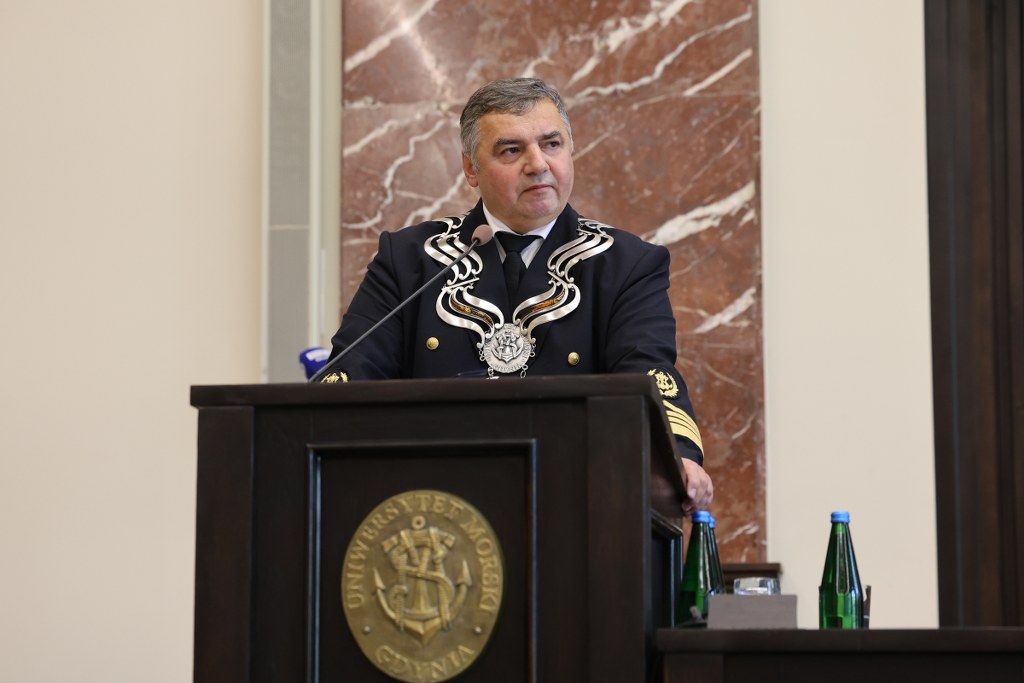
Address of the Rector of Gdynia Maritime University, Professor Adam Weintrit,
on the occasion of the 106th anniversary of maritime education in Poland
Esteemed Members of the Senate, Ladies and Gentlemen,
Every year, we celebrate our University Celebration Day twice – on 17 June and 8 December. Both dates hold particular significance for our academic community as they commemorate events that took place 106 years ago, marking the birth of our Alma Mater. It was in 1920 that the Minister of Military Affairs, General Józef Leśniewski, signed the order to establish the Maritime School in Tczew, which gave rise to what is today Gdynia Maritime University.
Today’s celebrations present an excellent opportunity to review the past six months and recall the key events and achievements that have shaped our University’s most recent history.
Ladies and Gentlemen,
The celebrations on 17 June are also a moment when we can speak with pride about the successes of our Staff, Students, and Doctoral Candidates. We will return to these achievements in greater detail later in the ceremony during the presentation of this year's distinctions, decorations, and awards.
At this stage, however, I would like to extend my heartfelt congratulations and express my deep appreciation for your daily work, commitment, and contribution to the advancement of knowledge, the maritime economy, and our University.
Ladies and Gentlemen,
The year 2026 began in a very distinguished manner for our University. On 27 January 2026, Dr Yohei Sasakawa, Honorary Chairman of The Nippon Foundation, became the third foreign national to join the ranks of honorary doctors of Gdynia Maritime University.
This highest academic honour of our University is conferred upon individuals who have rendered exceptional service to the advancement of knowledge, culture, the economy, maritime education, and social life, and whose activities and achievements represent a lasting contribution to the academic community and society at large.
We honoured Dr Yohei Sasakawa with the distinguished title of doctor honoris causa in recognition of his outstanding contribution to peace, public health, international cooperation, the promotion of intercultural dialogue, his commitment to building bridges between nations, and, above all, his role in shaping maritime policy and maritime safety.
I am convinced that Dr Sasakawa will play a significant role in the development of our University as its eminent ambassador and one of the pioneers of international maritime education. This is further reinforced by his long-standing and unceasing commitment to combating various forms of social exclusion and protecting our planet’s resources – with a particular emphasis on the shared heritage of the seas and oceans.
Ladies and Gentlemen,
The year 2026 is yet another year marked by numerous meetings, visits, and discussions with representatives of the Government and Parliament of the Republic of Poland concerning the construction of a successor to our sail training ship, the Dar Młodzieży. We have witnessed further milestone events that bring us closer to the construction of this new vessel.
In March, the Minister of Infrastructure, Mr Dariusz Klimczak, and the Deputy Minister of Infrastructure, Dr Arkadiusz Marchewka, personally informed us of the allocation of the first funding instalment to the University, amounting to over PLN 100 million, earmarked for the construction of the successor to the tall ship Dar Młodzieży.
Less than a month later, another event of fundamental importance for the future of maritime education in Poland took place. On 23 April 2026, Gdynia Maritime University announced a tender for a strategic investment project: the construction of a new training ship – a three-masted tall ship that will eventually replace the Dar Młodzieży.
We can already report an exceptionally high level of interest in the proceedings, as evidenced by the large volume of questions and requests submitted by prospective contractors via the procurement platform. The original deadline for the submission of bids was initially set for 29 May; however, at the request of interested shipyards, it has been extended to 1 July. I hope by then we will have received firm bids. When will we know which shipyard has won? Well, tendering processes have their own rules. I hope we will see a result before the end of this year – the sooner, the better. However, local shipyards currently have no shortage of orders, which does not necessarily help speed up the delivery of our plans.
Ladies and Gentlemen,
The participation of the Dar Młodzieży in the centenary voyage to the United States, which we announced two years ago, required and continues to require additional organisational commitment from us. It was necessary to adjust the vessel's itinerary appropriately so that Gdynia Maritime University students, as well as students from the maritime secondary schools with which we cooperate, could undertake their scheduled sea training placements. Consequently, the training season aboard the Dar Młodzieży began somewhat earlier than usual and will run slightly longer.
Our ship set sail on its first training voyage of the year on 2 March from the Pomeranian Quay in Gdynia, carrying a group of students from maritime secondary schools in Gdańsk, Szczecin, and Kędzierzyn-Koźle. On the next leg of the voyage, these young people were replaced by a group of students from Antwerp Maritime Academy in Belgium.
Esteemed Members of the Senate, Ladies and Gentlemen,
On 16 April this year, shortly after 2:00 pm, the Dar Młodzieży departed on an extraordinary voyage to the United States of America – perhaps the last of these great, historic expeditions. On that day, she was waved off by hundreds of people at the quay in Gdynia, including the Minister of Infrastructure, Dariusz Klimczak, the Mayor of Gdynia, Aleksandra Kosiorek, and leading representatives of the University.
It was a special moment for many reasons. Above all, the current voyage of the Dar Młodzieży continues one of the finest traditions in Polish maritime education, echoing the legendary expedition of the Dar Pomorza half a century ago. Crucially, it was exactly on 16 April 1976 that the white-and-red frigate set sail on a voyage to mark the bicentenary of US Independence, writing one of the most significant chapters in the history of Polish maritime education.
Today, fifty years later, the Dar Młodzieży once again proudly carries the Polish flag across the Atlantic, serving as a reminder of the long-standing traditions of Polish maritime education and confirming that Gdynia Maritime University remains the guardian and continuator of this unique heritage.
In a few days, our sail training ship, commanded by Captain Michał Sadowski and manned by a 33-strong crew alongside Gdynia Maritime University students, will arrive in the port of Norfolk. From there, she will sail to New York, where the highlight of the voyage will be the vessel’s participation in the international parade of tall ships on 4 July. From New York, the vessel will proceed to Boston. From there, the Dar Młodzieży will begin her return journey to Europe, arriving back at her home port of Gdynia on 24 August.
As I mentioned a moment ago, the start of this voyage was a truly unique occasion – doubly so, because immediately after clearing the port entrance breakwaters, the Dar Młodzieży began setting her sails one by one. This included a sail sewn specially to mark the centenary of Gdynia, which was presented on this scale for the very first time.
Ladies and Gentlemen,
At this point in my address, I would like to remind everyone that today is the final day on which name proposals for the successor to the Dar Młodzieży can be submitted to the email address zaglowiec@umg.edu.pl. Soon the competition will be concluded. Among the several thousand submissions received, we find names such as Gloria Polonia, Albatros, Panna Wodna, Pride of Poland, Joseph Conrad, Maurycy Beniowski, Dar Pomorza II, and Dar Narodu.
Interest in the competition has exceeded our wildest expectations. As agreed with the Ministry of Infrastructure, the winner will be announced during the steel-cutting ceremony at the shipyard selected to build the new vessel.
Ladies and Gentlemen,
The Dar Młodzieży is not the only vessel on which our students complete their practical training. On 1 June, the research and training vessel Horyzont II set sail on another voyage to Spitsbergen. It carried 18 student trainees from the GMU Faculty of Electrical Engineering, a faculty supervisor, and 15 polar researchers from the Institute of Geophysics of the Polish Academy of Sciences.
As part of the Spitsbergen expedition, the Horyzont II, alongside its training function, plays a vital logistics role. During the voyage, the vessel will deliver essential supplies to Polish research stations, including food, fuel, materials required for the daily operation of the facilities, and specialised research equipment.
Ladies and Gentlemen,
The university fleet also includes the research vessel IMOR, which completed its class renewal survey on 15 May. The shipyard work involved renewing the vessel's class certificates and its flag state safety certificate, both essential requirements for continued operations. During conservation and painting work, the above-water section received new colours visually aligned with the Gdynia Maritime University fleet, undergoing a comprehensive rebranding.
Esteemed Members of the Senate, Distinguished Guests,
From March 2025 to May 2026, the GMU Maritime Institute, acting as consortium leader alongside MEWO S.A. and the Polish Naval Academy, carried out a project commissioned by the Maritime Office in Gdynia entitled ‘Survey and potential neutralisation of hazardous materials remaining on the seabed of the Baltic Sea in selected locations’. The project involved large-scale hydrographic surveys and specialised chemical analyses of soil and water in the vicinity of the wreck of the Franken, as well as in the Gdańsk Deep and the Słupsk Furrow.
In terms of budget and scale, this project is the largest undertaking of its kind carried out in the Baltic Sea by the Maritime Office in Gdynia. A tangible outcome of this project is the evidence that the impact of wrecks, sunken conventional weapons, and the detected trace amounts of chemical weapons on the marine environment is lower than previously anticipated. The project was funded by the National Recovery Plan (KPO).
Ladies and Gentlemen,
In connection with the capital funding allocated and secured last year for the University's land-based investments, the past six months have been marked by the launch of two further tender procedures. In my view, these are critical to the continued operation and development of our campus. I hope that we will soon know the winning bidders so that the implementation of further capital projects can begin in the coming weeks, namely the construction of the GMU Computer Science Centre and a new student residence.
However, both investments will cause us a significant number of functional and logistical challenges regarding the operation and use of the adjacent Sports and Recreation Centre building, for which I would like to apologise in advance. Fire safety regulations regarding the provision of evacuation routes are uncompromising, and maintaining operational safety remains our absolute priority.
Ladies and Gentlemen,
Recent months at our University have seen intensive efforts to develop existing partnerships and forge new relationships, both nationally and internationally. During the past half-year, we hosted three foreign delegations, whose visits I view as strategically vital for the further development of Gdynia Maritime University, particularly regarding the internationalisation of education at the University.
From 22 to 24 April, Gdynia Maritime University hosted a visit by representatives of the Arab Academy for Science, Technology & Maritime Transport (AASTMT). The purpose of the meeting was to discuss opportunities for developing cooperation in education, as well as the exchange of students, doctoral candidates, and academic staff between our institutions. The AASTMT is a major university centre supporting the development of the maritime economy in the Middle East and North Africa. Its maritime students train under a model very similar to the one used at our University, where practical experience is considered just as important as theoretical classes.
Ladies and Gentlemen,
A month ago, from 6 to 12 May, as a continuation of our long-standing cooperation with Hochschule Bremerhaven (University of Applied Sciences), the University hosted the 21st Polish-German Student Seminar, entitled ‘Managing Cultural Diversity in Europe’. The seminar was organised jointly by Gdynia Maritime University and Hochschule Bremerhaven under the patronage of the Rectors of both institutions. This recurring event, held annually for over 20 years, aims to familiarise Polish and German students with the academic environment of both universities and encourage them to undertake studies at partner institutions under the Erasmus+ programme.
Esteemed Members of the Senate, Ladies and Gentlemen,
At the beginning of June, during the University's inaugural ‘Africa Day,’ we had the honour of hosting the ambassadors of Angola, Algeria, and Senegal. The event provided a unique platform for dialogue and the exchange of views between representatives of the academic community, the diplomatic corps, and students interested in international exchange programmes.
I am confident that ‘Africa Day’ will become a permanent fixture in the University’s calendar and an important element in building lasting relations with African partners. In the future, this will bear fruit in further joint scientific and educational projects, including an increasing number of students from African nations choosing to study at our University. However, we must look into making these gatherings even more engaging in the future by incorporating elements of folklore, cuisine, music, traditional dance, and song.
Ladies and Gentlemen,
We have also been active participants in international symposia, sessions, and scientific conferences, acting both as attendees and organisers.
From 23 to 27 February this year, I attended the 12th session of the IMO Sub-Committee on Human Element, Training & Watchkeeping (HTW 12), a United Nations agency. During the event, we joined a panel of experts to discuss a comprehensive review of the STCW Convention and Code, new technologies and alternative fuels, the prevention of fraud, medical certification, reporting and monitoring via the Global Integrated Shipping Information System (GISIS), and updating the content of IMO model training courses.
On 14 April, Gdynia Maritime University hosted a seminar entitled ‘Green Fuels Supply Chain Seminar’. The event was organised as part of the DeCoInter project (Decarbonisation of the Maritime Sector and Its Impact on Green Energy Transition), which aims to support regional ports in implementing the green energy transition within the maritime and transport sectors.
From 20 to 23 April, I had the honour of attending the 4th Assembly of the International Hydrographic Organization (IHO) in Monaco as an official observer on behalf of the International Association of Institutes of Navigation (IAIN). The organisation coordinates and oversees the hydrographic activities of member states, with a particular focus on ensuring safety of navigation and protecting the marine environment. One of the guests of honour at the Assembly was a representative of The Nippon Foundation, which sponsors one of the IHO's largest initiatives under GEBCO (General Bathymetric Chart of the Ocean) – the Seabed 2030 project.
On 12 May, at the invitation of the organisers, I took part in the first Polish-Swedish symposium on ‘Naval Evolution of Research & Design’ (NERDS), organised in Gdynia by MMC Ship Design & Marine Consulting and Saab Kockums.
A few days earlier, on 8 May, I participated in the 2nd Forum of Rectors of Poland and Türkiye held in Gdańsk at the University of Gdańsk Library. On that day, I had the privilege of signing three cooperation agreements between Gdynia Maritime University and Turkish higher education institutions: Istanbul Technical University, Karadeniz Technical University, and Dokuz Eylül University. We have cooperated with these institutions for many years within the International Association of Maritime Universities (IAMU).
Also in May, from 25 to 27 May, the 10th Metrology Congress took place in Jastarnia. Gdynia Maritime University co-organised the event alongside the Committee on Metrology and Scientific Instrumentation of the Polish Academy of Sciences. The Congress was attended by approximately 120 participants, including scientists and representatives of industry, state, and military institutions from across Poland, representing 26 institutions based in 15 Polish academic centres. I had the honour of extending my Honorary Patronage to this prestigious event, as well as delivering an invited lecture dedicated to maritime units of measurement past and present.
Since Sunday, 14 June, the 25th National Electronics Conference (KKe’26), from which I returned just yesterday, has been underway in Darłowo and. It is organised by staff from the GMU Faculty of Electrical Engineering under the chairmanship of Professor Janusz Zarębski, the former Rector of our University.
Ladies and Gentlemen,
We have also participated in a series of events related to the development of the maritime industry.
On 9 March this year, at the invitation of the President of the Republic of Poland, I attended a meeting with representatives of the Maritime Convention at the Belweder Palace. The Convention is being gradually rebuilt following the passing of its former chairman, Master Mariner Zbigniew Sulatycki, an honorary doctor of our University. The meeting was chaired by Associate Professor Captain Henryk Śniegocki.
From 18 to 19 March, I had the pleasure of participating in the 15th Transport Week event alongside Deputy Minister Dr Arkadiusz Marchewka. This year’s event focused on port infrastructure development, cargo handling trends, and technological innovations in maritime logistics.
From 18 to 20 March, representatives of our University, including our students, took part in the PowerConnect Energy Fair – one of the industry's premier events dedicated to modern energy technologies, the energy transition, and the development of the offshore sector.
On 15 April, I had the honour of taking part in a debate on the future of the Polish shipbuilding industry and the wider maritime economy, held in the Hall of Tradition at the Remontowa Shipyard. The meeting was organised as part of the General Assembly of Members of the Association of Polish Maritime Industries (FORUM OKRĘTOWE), into which Gdynia Maritime University was admitted as a member in April this year.
From 13 to 14 May, alongside several representatives from our University, I had the pleasure of participating in the 12th International Maritime Congress in Szczecin – one of the key events dedicated to the maritime economy, safety, and the future of transport and maritime infrastructure in the Baltic Sea region.
Ladies and Gentlemen,
The past six months have also been rich in events aimed directly at our students, as well as prospective candidates interested in studying at our University.
On 6 March, we welcomed over 1,400 visitors to Gdynia Maritime University’s first Open Day of the year, organised for future students of our institution.
On 15 April, the Faculty of Electrical Engineering Day, also known as ‘Electrical Engineer’s Day,’ was held for the second time in its new format. The event brought together approximately 300 participants, including more than 200 secondary school students and representatives from dozens of companies across the power engineering, electronics, IT, automation, and robotics industries. Electrical Engineer’s Day provided an excellent opportunity to present the education offered at the Faculty of Electrical Engineering, promote cutting-edge technologies, and facilitate direct networking between students and prospective employers.
Just a few days later, on 16 April, the first-ever Faculty of Management and Quality Science Day took place in the sports hall of the GMU Sports and Recreation Centre – an event designed to integrate the academic community. The programme included lectures, workshops, a handicraft exhibition, presentations by student scientific societies, an employer fair, and numerous activities promoting the Faculty's study programmes and career development opportunities for students.
In the second half of April, the University also hosted its Careers Fair – an event tailored for students and graduates from all faculties looking for internships and future employment.
May also saw the annual sports and recreation event organised by Gdynia Maritime University – GMU Sports Day. For the first time, 8 teams competed in the events, representing our 5 faculties, the GMU Maritime Institute, the Rector's Division, and the Chancellor's Division (which until recently competed together under the title of Central Administration). At this point, I would like to extend my heartfelt thanks to Father Dr Edward Pracz for making the Stella Maris Centre in Kashubia available, where all the water sports disciplines were held. The land-based competitions were held two days later at our Sports and Recreation Centre. I extend my thanks once again to the Director of the Centre, Dr Andrzej Lachowicz, and his team for the smooth coordination of the event.
Also in May, the Faculty of Navigation organised the 2nd edition of Navigator’s Day – an event bringing together students, University staff, and representatives from the maritime, logistics, and offshore industries. The programme featured a jobs fair with companies and institutions cooperating with Gdynia Maritime University, alongside sports and recreational competitions held on Gdynia beach.
We have also recently concluded an exceptionally successful third edition of the Maritime Science Festival – a unique event popularising science, research, and innovative solutions related to the maritime economy, technology, and sustainable development. Held from 11 to 13 June, the festival once again drew hundreds of interested attendees from across our University.
Ladies and Gentlemen,
In keeping with tradition, the University hosted two formal galas over the past six months: the Maritime Ball and the Student Ball, the latter organised by the GMU Student Parliament. This year also marked the third post-pandemic staging of our student festival, Delfinalia, Gdynia’s vibrant equivalent to the traditional Juwenalia or Gdańsk's Neptunalia.
Ladies and Gentlemen,
A university is built on far more than celebrations and social events. The first half of the current term of the University authorities is drawing to a close. We find ourselves at an important juncture, although many uncertainties still lie ahead. We are currently awaiting the results of this year's evaluation of the quality of the University's scientific activity. In preparing our submissions, we sought to obtain the highest possible scientific categories, which will support our continued academic development, enable us to confer academic degrees, and allow us to continue educating doctoral candidates within our Doctoral School.
We also eagerly anticipate the new Higher Education Act and its accompanying statutory instruments, and, above all, the results of this year's student recruitment. Without students – and consequently, without an engaging, attractive educational offering that draws secondary school graduates – the remainder of our institutional activities would significantly lose their meaning.
Ladies and Gentlemen,
The year 2026 is a milestone year for Gdynia, as our city celebrates its centenary of being granted city rights. Gdynia Maritime University has been actively involved in celebrating this unique centenary from the very beginning.
On 10 February, during the ceremonial session of the Gdynia City Council that launched the centenary celebrations, I had the honour of participating in an event highlighting Gdynia’s role as a modern economic, scientific, and maritime hub. On the same day, alongside our ceremonial flag party, we took part in the official celebrations held next to the warship ORP Błyskawica.
In the months that followed, representatives of Gdynia Maritime University participated in numerous initiatives forming part of the celebrations for the City of Gdynia’s centenary. On 18 February, I had the honour of attending the opening of the exhibition ‘GDYNIA X 10’ at the Senate of the Republic of Poland, an exhibition charting the history and growth of our city over the past century.
A focal point of the centenary celebrations was the Gdynia Rectors' Panel Debate entitled ‘Gdynia! A Choice for Today. A City for Tomorrow,’ in which I had the pleasure of participating. This debate inaugurated a series of popular science lectures prepared by Gdynia's four higher education institutions, including Gdynia Maritime University, specifically for the centenary. Two lectures given by our academic staff for the residents of Gdynia have already taken place. The subject of each lecture stems directly from the daily work, research, and teaching activities of our academic staff. I hope that everyone present here will find something of interest within the programme. The next planned lecture, to which I extend a warm invitation now, will take place on 2 July.
It is well worth noting that our University played a pre-eminently city-shaping role alongside the port, shipyards, and shipping companies. Many of our tens of thousands of graduates and staff established families and settled permanently in Gdynia, becoming its citizens.
Ladies and Gentlemen,
At the end of May, at the invitation of the Senate of the Republic of Poland, I had the honour of participating in an away meeting of Senate Committees held at the Museum of Emigration in Gdynia. The session was dedicated, among other matters, to the protection of Gdynia's modernism and the steps being taken to include our city centre on the UNESCO World Heritage List.
Ladies and Gentlemen,
The history of our University is inextricably linked with the history of Gdynia and the Polish maritime economy. Therefore, as in previous years, our academic community and students participated in the anniversary celebrations of Poland's Marriage to the Sea in Puck, commemorating the historic events of 1920 when General Józef Haller – Commander of the Pomeranian Front – performed the symbolic wedding of Poland to the Baltic Sea in fulfilment of the provisions of the Treaty of Versailles.
Furthermore, on 8 April, representatives of our University took part in a flower-laying ceremony on the waters of Gdańsk Bay to mark the 85th anniversary of the death and the 25th anniversary of the symbolic scattering of the ashes of General Mariusz Zaruski – an outstanding sailor, educator of youth, patriot, and one of the pioneers of Polish maritime education.
Ladies and Gentlemen,
Another academic year in the history of our 106-year-old University is drawing to a close. It has been a period of intensive work, ambitious undertakings, and numerous successes for the entire Gdynia Maritime University community.
Naturally, it is impossible to list all the achievements of recent months in this brief address. I therefore encourage you to read the latest issue of the Gdynia Maritime University newsletter (Uniwersytecki Kurier Morski), which documents the key events from the life of our Alma Mater, and to regularly visit the University website.
Esteemed Members of the Senate, Ladies and Gentlemen,
We now proceed to the second part of the Open Session of the Senate, during which awards, medals, and distinctions will be presented.
In closing, I would like to extend my heartfelt thanks to all of you for your presence today, and offer my warmest congratulations to all those being honoured with awards and distinctions. Today’s decorations are a true testament to your hard work, expertise, and commitment.
Thank you once again for your daily efforts and your unceasing care for the continued development of Gdynia Maritime University.
Thank you very much.